For centuries, astronomers have searched the outer edges of the solar system for evidence of an unseen world. Long before modern telescopes, infrared surveys, and orbital calculations, the ancient Sumerians described a mysterious celestial body called Nibiru — "the Planet of the Crossing."
In my research on Ancient Astronauts, Planet X represents one of the most fascinating overlaps between ancient astronomical knowledge and modern scientific investigation. The question is simple: did the Sumerians preserve knowledge of a distant planetary body that modern astronomy is still trying to confirm?
NASA, Planet X, and the Modern Search
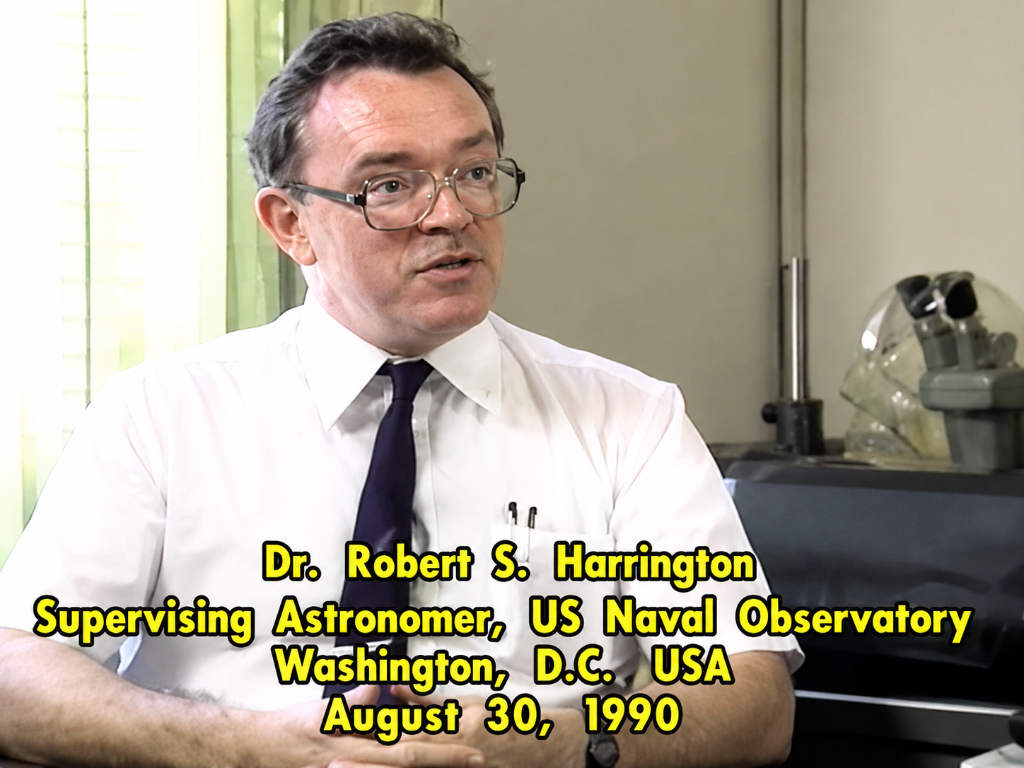
In the early 1990s, calculations from the United States Naval Observatory suggested that unusual orbital perturbations in Uranus and Neptune could potentially be explained by a single undiscovered planet. Astronomers such as Dr. Thomas C. Van Flandern and Dr. Robert Harrington calculated that such a planet could be several times more massive than Earth and moving through a highly elliptical orbit far beyond Pluto.
This is important because the discovery of planets beyond Saturn has often depended not on direct visual observation, but on mathematics. Uranus was found in 1781. Neptune was later predicted through orbital calculations and confirmed in 1846. Pluto was discovered in 1930 after continued searches for a trans-Neptunian body.
The search for Planet X follows that same pattern: gravitational disturbances, mathematical modeling, sky surveys, and the possibility that something large remains hidden in the deep outer solar system.

The Sumerian Description of Nibiru
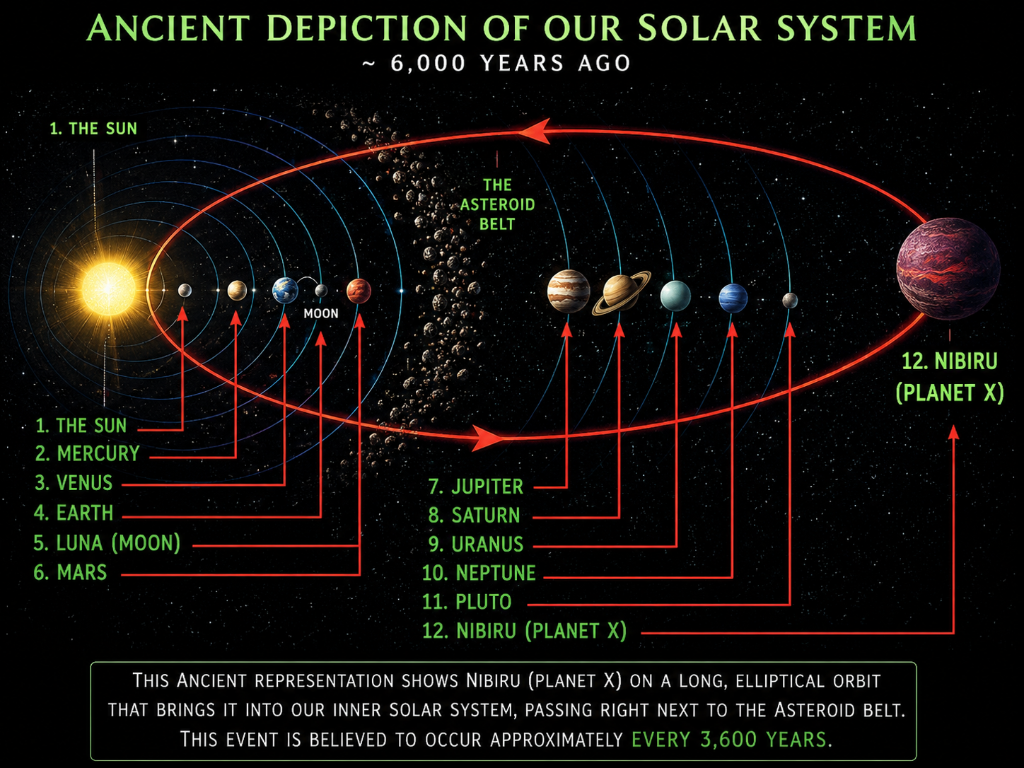
According to ancient Sumerian descriptions, our solar system included one additional planet: Nibiru, the Planet of the Crossing. This world was said to follow a long, comet-like orbit that carried it far beyond the known planets before returning periodically through the inner solar system.
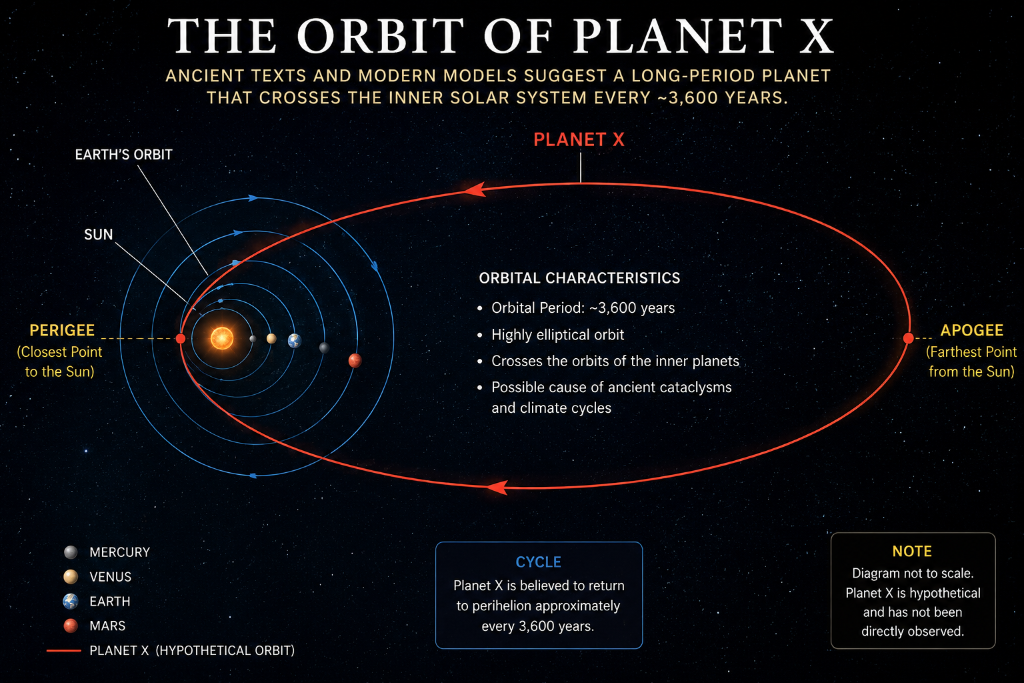
The descriptions attributed to the Sumerians suggest a planet several times larger than Earth, moving on a vast elliptical path around the Sun. This directly parallels the modern idea of a hypothetical Planet X: a distant, unseen body whose gravitational influence might explain anomalies in the outer solar system.
Why has it not been seen in recent history? If Nibiru follows an orbit that takes it far beyond Pluto, then it would spend most of its cycle in regions of space difficult to observe from Earth.
The Timeline of Planet X Research
The modern scientific search for Planet X goes back nearly two centuries.
In 1841, John Couch Adams began studying irregularities in the motion of Uranus. Urbain Le Verrier soon pursued the same problem, proposing that an unknown planet could be affecting Uranus gravitationally. This work led directly to the discovery of Neptune.
Only one week after Neptune was discovered in 1846, Le Verrier suggested there might still be another unknown planet beyond it. Later, in 1877, David Todd attempted to locate a trans-Neptunian planet using residuals in Uranus's motion. In 1879, Camille Flammarion noted that the aphelia of periodic comets appeared to cluster near the orbits of major planets, hinting at possible gravitational relationships in the outer solar system.
Percival Lowell later made Planet X famous. He built Lowell Observatory in Flagstaff, Arizona, and spent years searching for the missing planet. Although Lowell did not find Planet X, his observatory later became the site where Pluto was discovered in 1930.
The Sumerians, Tiamat, and the Formation of Earth
The Sumerian creation accounts describe a dramatic celestial collision involving a primordial world called Tiamat and the incoming planet Nibiru. According to this interpretation, Earth was formed from the remains of Tiamat after a catastrophic encounter with Nibiru or its satellites.
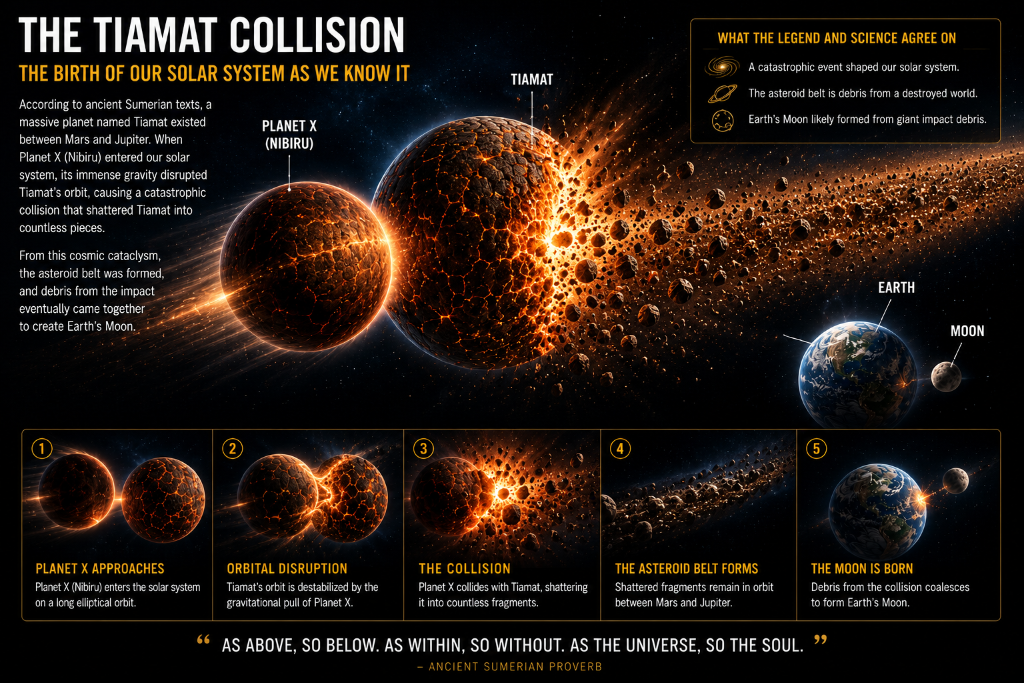
This idea is connected in the research to the ancient explanation for why Earth's continents appear as if they were once part of a larger unified landmass. Modern geology describes this as Pangea and plate tectonics. The Sumerian interpretation goes further, asking whether Earth itself may be the remnant of a much larger original planet.
In this view, the asteroid belt is also tied to the aftermath of that ancient collision.
Counting the Planets from the Outside In
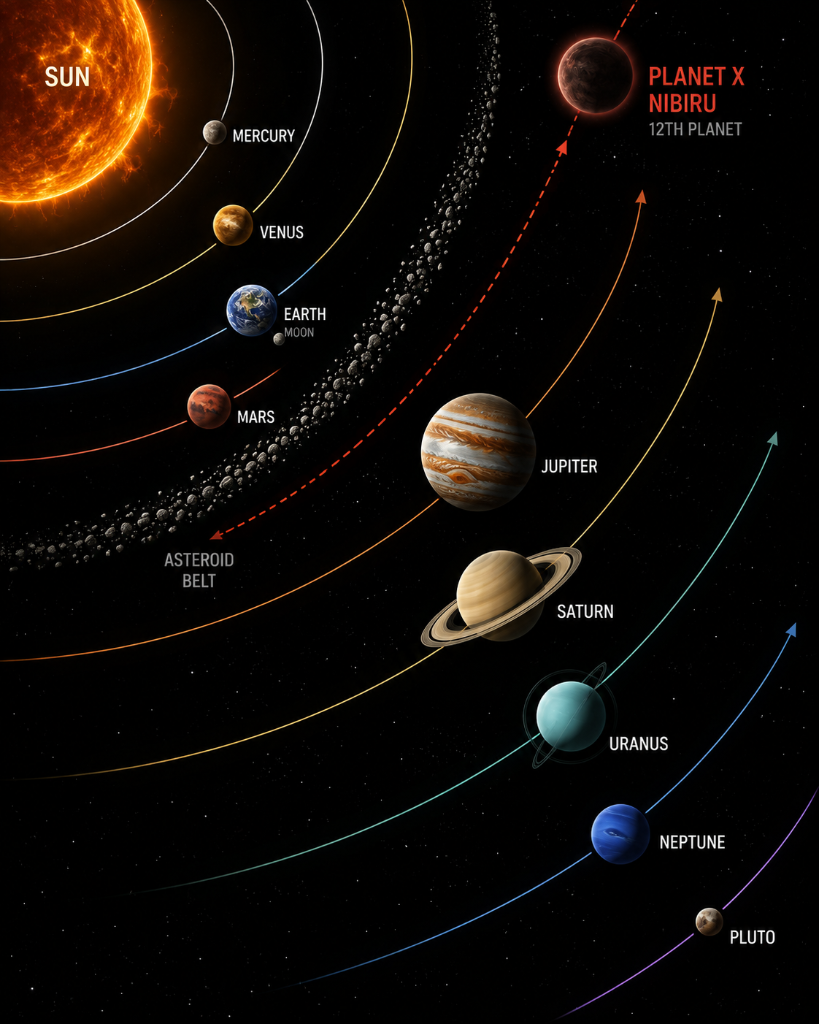
One of the more interesting points in the research involves perspective. Modern astronomy counts Earth as the third planet from the Sun. But an approaching visitor entering the solar system from the outside would encounter Pluto first, then Neptune, Uranus, Saturn, Jupiter, Mars, and then Earth.
From that viewpoint, Earth becomes the seventh planet.
This outside-in perspective is significant when comparing modern solar system diagrams with ancient descriptions that appear to count celestial bodies differently than we do today.
The Winged Globe and the Planet of the Crossing
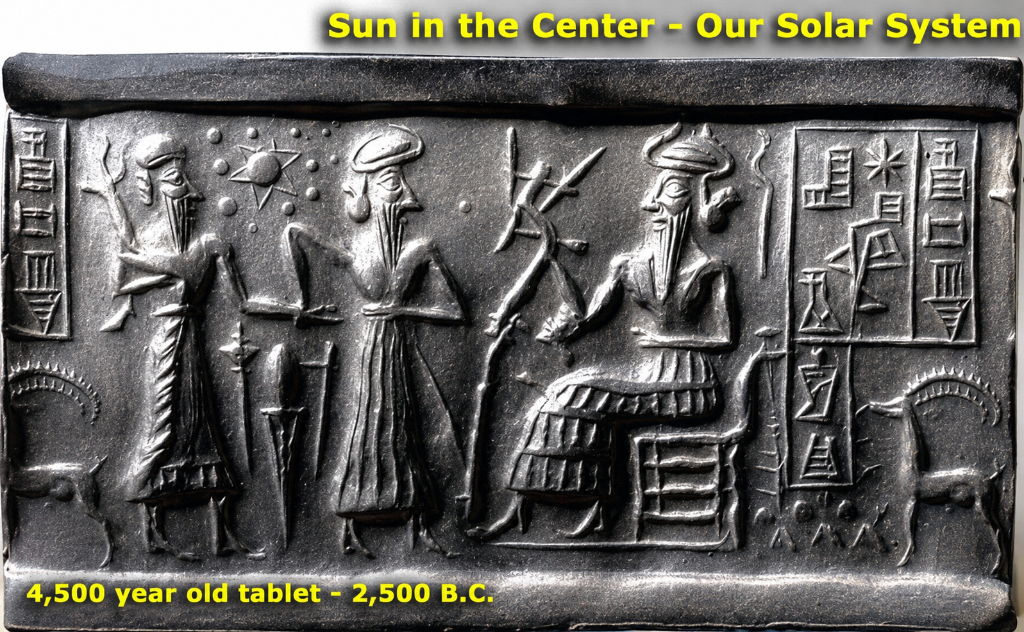
Across the ancient Near East, one symbol appears again and again: the Winged Globe. It is found above kings and priests, carved into temples, etched into cylinder seals, and painted on walls.
In this research, the Winged Globe is interpreted as a celestial symbol connected to the 12th Planet — Nibiru. Mesopotamian texts describe the planet as radiant, visible in the sky, and associated with a predictable return.
The pictographic sign for the Planet of the Crossing was a cross. This symbol also carried meanings connected with divinity and later evolved in Semitic languages into the letter tav, meaning "the sign."
Nibiru's Return and the Ancient Expectation of Upheaval
Ancient Mesopotamian and biblical traditions describe the return of this celestial body as a time of dramatic change. The nearing planet was associated with rains, flooding, earthquakes, and upheaval.
The texts describe the planet's periodic appearance as something expected, charted, and observable. It was not treated as a random omen, but as a recurring celestial event.
In this framework, the "Kingdom of Heaven" was not only spiritual language. It may have been rooted in the physical return of a powerful celestial body whose arrival marked the beginning of a new era.
The 3,600-Year Shar Cycle
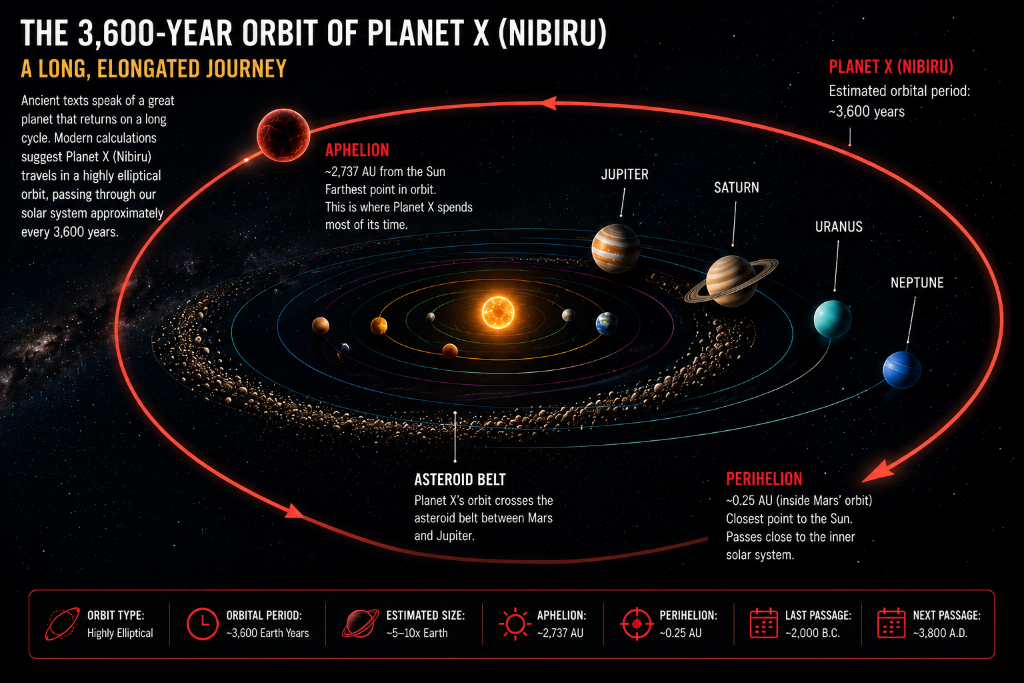
A key part of the Planet X/Nibiru research is the Sumerian term shar. In Sumerian, shar was represented by a large circle and carried multiple meanings: a completed cycle, a perfect circle, and the number 3,600.
The research connects this number to the proposed orbital period of Nibiru. The idea is that the reign periods recorded in Sumerian texts may reflect multiples of this 3,600-year celestial cycle.
If Nibiru's orbit is approximately 3,600 years, then its periodic return would have been rare enough to become mythologized, but regular enough to be remembered through astronomical tradition.
Charting Nibiru's Path
Some interpretations of Sumerian cylinder seals suggest that ancient astronomers tracked the movement of Nibiru at key points in its approach.
The research identifies three major observational points:
Point A: The first visible alignment as the planet approaches the inner solar system near Mercury.
Point B: A later crossing near Jupiter's orbit.
Point C: The location associated with the ancient collision point involving Tiamat and the formation of Earth.
This suggests that the ancients were not simply telling symbolic stories. They may have been preserving a technical astronomical memory encoded in myth, symbol, and religious language.
Scientific Searches and the Harrington Connection
Robert S. Harrington's work is central to the modern Planet X search. His research used observed positions of Uranus and Neptune, along with residuals in right ascension and declination, to constrain the possible location of a tenth planet.
One proposed region placed Planet X toward Scorpius, with another possible but less likely region toward Taurus. Searches involved photographing southern sky regions from New Zealand and blinking plates in Washington to identify objects that moved between exposures.
Other scientific approaches examined whether comet families, orbital residuals, and perturbations in the outer planets could point toward a hidden planetary mass.
Why Planet X Still Matters
The search for Planet X is more than a fringe curiosity. It sits at the crossroads of astronomy, ancient history, mythology, and the possibility that early civilizations knew more about the solar system than we have been willing to admit.
Modern astronomy has repeatedly expanded the known boundaries of the solar system. Ancient texts, meanwhile, describe a mysterious crossing planet, a long orbital cycle, and a celestial body tied to catastrophe, renewal, and divine rulership.
The core question remains:
Did the Sumerians encode an advanced astronomical understanding of a distant planetary body — one that modern science is only now beginning to search for again?
Conclusion: Ancient Knowledge and the Search Ahead
Planet X, Nibiru, the 12th Planet, the Planet of the Crossing — whatever name we use, the idea points to one of the most provocative possibilities in ancient astronaut research.
The Sumerian material describes a distant, returning celestial body with a long orbital cycle. Modern science has searched for unseen planets using mathematics, orbital perturbations, comet behavior, infrared imaging, and deep-sky photography.
The evidence is still debated. But the pattern is compelling: ancient records and modern astronomy both point toward the same mystery — something may still be waiting in the darkness beyond the known planets.
The search for Planet X continues.